

For sellers on Flipkart, Amazon India, Myntra, AJIO, Meesho, Nykaa and Snapdeal. Updated August 2026.
Direct Answer
Big Billion Days seller claims are the return and damage claims Indian marketplace sellers must file after the festive sale, and they fail for one structural reason: the sale multiplies order volume by four to six times, but claim windows stay exactly the same length. AJIO still allows 3 days with mandatory video. Flipkart still allows 48 to 72 hours. Myntra still allows around 48 hours. A team that comfortably filed 20 claims a week now has to file 200 inside identical windows, and the claims that expire are not recoverable at any price. Sellers typically lose 8 to 15 percent of monthly revenue to unrecovered returns in normal months, and festive return rates run up to 40 percent against a 15 to 35 percent baseline. The sellers who recover during the sale are not filing faster. They captured Order ID-linked packing evidence before the sale opened, so filing takes seconds instead of minutes.
What Are Big Billion Days Seller Claims?
Big Billion Days seller claims are the compensation claims a seller files with a marketplace after a return arrives damaged, wrong, short, or empty, during and after the festive sale period.
Big Billion Days typically runs for five to seven days in late September or early October, timed ahead of Diwali, with Flipkart Plus members getting early access before general shoppers. Amazon's Great Indian Festival runs in the same window, and Myntra, AJIO, Meesho and Nykaa all run their own festive events alongside. Many brands generate 15 to 20 percent of annual revenue in this single stretch.
The claim itself is not new. What makes Big Billion Days seller claims different is scale and compression arriving at the same time.
The claim types that arrive after a festive sale:
- Damaged on arrival, where the customer says the item reached them broken
- Wrong item received, where the customer says a different product was shipped
- Quantity short, where a multi-item or combo order is claimed as incomplete
- Empty box or box-of-rocks returns, where the parcel comes back with nothing or with filler
- Used or swapped item returned, where an old unit is returned in place of the new one bought at sale price
- Non-returnable item return accepted in error by the marketplace, leaving the seller carrying the cost
Every one of these is filed against you by default. The marketplace does not investigate whether you were right. It applies its policy, deducts, and gives you a window to dispute. Whether you recover depends entirely on whether you file inside that window with evidence the platform accepts.
Sellers without a structured proof system win under 25 percent of claims. Sellers with Order ID-linked packing video routinely reach 90 percent. That gap is the difference between the festive sale being your most profitable week and your most expensive one.
For the year-round version of this problem, see our How to Reduce Ecommerce Return Rate playbook and our Reduce RTO playbook at trackvid.in.
Why Do Claim Windows Break During Sale Season?
This is the mechanic almost every festive-season guide misses, and it is the entire reason Big Billion Days seller claims go unrecovered.
Your order volume multiplies. Your claim windows do not.
A seller doing 300 orders a day might do 1,800 during the sale. Six times the volume. The returns that follow scale with it. But AJIO still gives 3 days to raise the claim. Flipkart still gives 48 to 72 hours. Myntra still gives roughly 48 hours. Not one platform extends its window because you had a good sale.
So the arithmetic breaks in a specific place. If filing one claim manually takes 15 minutes of finding the order, locating footage, exporting it, logging into the portal and uploading, then 20 claims a week is five hours of work. Manageable. During the sale, 200 claims a week is fifty hours of work, arriving in a week when your team is already handling dispatch, customer queries and courier escalations.
The sale multiplies your orders. It does not multiply your claim windows.
Four things compound the compression:
The return wave arrives after the sale, not during it. Orders ship during the sale week. Return windows then run their course, so the returns land seven to twenty-one days later. Your claim workload peaks when the sale is already over and the team has mentally moved on.
Every marketplace's sale runs at once. A multichannel seller is simultaneously handling Big Billion Days on Flipkart, Great Indian Festival on Amazon, and festive events on Myntra, AJIO and Meesho. Five portals, five different window lengths, five different evidence formats, one team. This simultaneity is what turns a manageable process into an impossible one.
Festive return rates run higher than baseline. Indian ecommerce return rates sit at 15 to 35 percent depending on category, with fashion at 25 to 35 percent per IBEF data. Festive season returns have been recorded running as high as 40 percent. So the return rate rises at the same time the order base multiplies.
A missed window is permanently unrecoverable. This is what makes claim expiry different from every other operational failure. A late dispatch can be apologised for. A missed claim window cannot be reopened at any price. The money is simply gone, and it is gone silently, because nobody generates a report of claims that expired unfiled.
For the operational side of the same surge, capacity and WISMO planning, see our Sale Season Operations Playbook at trackvid.in. This blog covers what that one does not: the claim and evidence side.
Which Marketplace Claim Windows Apply During the Festive Sale?
Knowing the exact window per platform is the foundation of the whole playbook, because your process has to be designed around the shortest one, not the average.
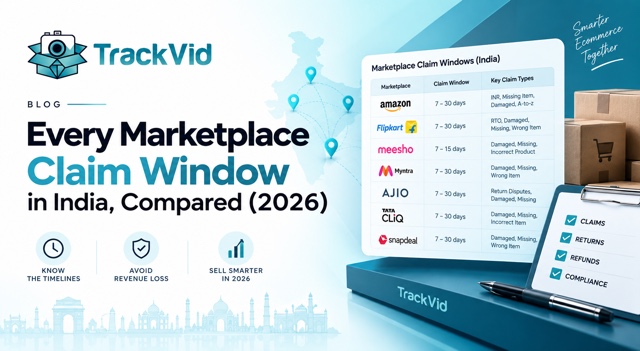
| Marketplace | Claim window | Mechanism | Key requirement |
|---|---|---|---|
| AJIO | 3 days | Seller Portal plus email | Order-level packing video is mandatory. Claims without compliant video are auto-rejected before human review |
| Myntra | Around 48 hours | Seller Portal | PPMP compliance, packing video |
| Flipkart | 48 to 72 hours | Seller Portal Returns | SPF compliance, video with visible timestamps |
| Amazon India | 7 days from return delivery | SAFE-T in Seller Central | Order-linked packing and opening video |
| Meesho | 7 days from receipt | Seller Panel | Photo plus video, manual review |
Design for AJIO, not for Amazon. If your process can handle a 24-hour window, it handles everything else automatically. If you design for the 7-day SAFE-T window, you will miss every AJIO claim during the sale. Most sellers unconsciously design for the comfortable window and then wonder why one platform's recovery rate is near zero.
AJIO's CCTV-required emails do not wait for business hours. They arrive on Saturdays, on festival days, at 11pm. During the sale period they arrive in volume. If responding requires a person to be at a desk, your AJIO recovery rate during the festive season will be a fraction of what it should be.
The windows overlap in a single fortnight. In the two weeks after the sale, you are running 24-hour AJIO responses, 48-hour Myntra filings, 72-hour Flipkart filings and 7-day Amazon SAFE-T claims concurrently. Without a single evidence source that serves all five, the process is five separate manual jobs.
The 5-Move Big Billion Days Seller Claims Playbook
This playbook is organised around the claim clock rather than the calendar, because the binding constraint is window length, not preparation time.
Move 1: Build Your Claim Window Matrix Before the Sale Opens
You cannot run five portals from memory during the busiest fortnight of your year.
- List every marketplace you sell on, with its exact claim window, filing mechanism, and evidence format requirement.
- Sort by window length, shortest first. Your process gets designed around the top row, which for almost every Indian seller is AJIO.
- Note the trigger event for each window. Some windows start from return delivery, some from marketplace notification, some from the customer's claim. Getting this wrong costs you claims that you believed were still open.
- Assign a named owner per platform, not one person for everything. During the sale, a single owner becomes a single point of failure.
Move 2: Calculate Your Claim Capacity Gap
This is a fifteen-minute calculation that almost no seller does, and it usually produces the number that forces action.
The formula:
Expected sale orders × expected return rate × claim-eligible share = expected claims
Expected claims × minutes per claim ÷ 60 = hours required
Compare hours required against hours actually available in your team during the post-sale fortnight.
A worked example. A seller expecting 12,000 orders across the sale window, at a 28 percent return rate, with 20 percent of returns being claim-eligible, faces about 670 claims. At 15 minutes each, that is 167 hours of filing work. If your team has 40 hours available for claims in that fortnight, you will file roughly 24 percent of them and the remaining 76 percent will expire.
That gap is the number worth carrying into every other decision. It converts an abstract worry into a specific figure, and it tells you exactly how much the filing time per claim needs to fall.
Move 3: Capture the Evidence Layer Before the Sale, Not During It
This is the only move that cannot be done retroactively, and it is the one that collapses the number in Move 2.
Every order dispatched during the sale needs a packing record linked to its Order ID, capturing the item, the quantity, the condition, the weight, and the tamper-evident seal, with the shipping label visible in the same frame.
Deploy at least three to four weeks before the sale opens. A system introduced during the sale gets abandoned during the sale. A system that has been running through a normal month survives the surge because the team already uses it without thinking.
The reason this matters more than any other single change: filing time per claim is the multiplier on your entire capacity gap. If retrieval takes ten minutes because someone is scrubbing through CCTV by timestamp, no amount of staffing fixes the arithmetic. If retrieval takes under two minutes because the video is indexed by Order ID, the same team files four to five times more claims in the same hours.
For the operational build, see our Order Accuracy playbook and Packaging Best Practices playbook at trackvid.in.
Move 4: Automate the Short Windows, Batch the Long Ones
Not every window needs the same treatment, and treating them identically is what wastes your scarce hours.
- 3 day windows (AJIO): automate fully. Detection of the CCTV-required email and the response with the correct order-linked video should require no human step. Anything needing a person to be awake will fail during the sale.
- Around 48 hour windows (Myntra): file same-day, twice daily, in fixed slots. Morning and evening batches, with a named owner per slot.
- 48 to 72 hour windows (Flipkart): file daily in one fixed slot, with a written checklist so the evidence set is complete on the first submission.
- 7 day windows (Amazon SAFE-T, Meesho): batch every second day. These are the only claims that can safely wait, so they should absorb the flexibility rather than competing with the urgent ones.
- Never let long-window claims consume short-window hours. The most common failure is a team spending Monday on comfortable SAFE-T filings while AJIO windows expire in the background.
Move 5: Run a Claim Sweep Before the Last Window Closes
The final move recovers claims that are still open but unnoticed.
- On day 5 after the sale ends, and again on day 12, reconcile every return received against claims filed. The gap is your list of unfiled claims still inside their windows.
- Cross-check returns against dispatch weight. A return significantly lighter than its dispatch weight is an empty-box or short-shipment case, and these are the highest-value claims most often missed because nobody weighed the parcel.
- Log every expired claim with its value. This is the number that justifies next year's preparation, and without it the loss stays invisible forever.
- Feed repeat claimants into your risk list so the same accounts do not repeat next festive season. See our Customer Risk Scoring playbook at trackvid.in.
Jaipur Seller Meghna: 41 Percent to 94 Percent Filed in Time
Meghna runs an ethnic wear and apparel business from Jaipur, selling across Flipkart, Myntra, AJIO, Meesho and Amazon India. Normal volume is around 320 orders a day. During last year's festive sale window her peak crossed 1,850 orders a day, with roughly 11,400 orders shipped across the sale period.
What last festive season looked like:
The returns started landing about ten days after the sale ended. Around 28 percent of sale orders came back, and roughly 640 of those returns were claim-eligible: damaged, wrong item, quantity short, or clearly swapped.
Her team had CCTV covering the packing floor, so in principle the proof existed. In practice, finding the footage for a specific Order ID meant scrubbing through hours of timestamped recording, and the clip they eventually found showed a packing table, not a documented link between that order and that product.
- Claims filed inside window: 262 of 640, which is 41 percent
- Claims that expired unfiled: 378
- Average claim value: approximately ₹820
- Value of expired claims: approximately ₹3.1 lakh
- Win rate on the claims she did file: 38 percent
- Average filing time per claim: about 14 minutes
- AJIO recovery specifically: close to zero, because the CCTV-required emails arrived faster than anyone could respond
"I knew we had shipped correctly. But by the time we found anything, the window had closed. We were not losing claims. We were never even filing them," Meghna said.
What changed before the following sale:
Five weeks out, she built the claim window matrix and discovered her team had been treating AJIO like Flipkart, which explained the near-zero AJIO recovery.
Four weeks out, she ran the capacity gap calculation. At 14 minutes per claim and 640 expected claims, the requirement was 149 hours against roughly 45 available. The gap made the decision obvious.
Four weeks out, Order ID-linked packing video was deployed via TrackVid across her pack stations, with weight capture and tamper-evident sealing, giving the team a full normal month to get used to it before the sale.
During and after the sale, short windows were automated, long windows batched, and claim sweeps were run on day 5 and day 12.
Results across the following festive sale:
- Claims filed inside window: 41 percent to 94 percent
- Average filing time per claim: 14 minutes to about 40 seconds
- Win rate on filed claims: 38 percent to 86 percent
- AJIO recovery: from near zero to comparable with her other channels, through automated response to CCTV-required emails
- Empty-box and quantity-short claims caught through weight reconciliation: 71 that would previously have gone unnoticed entirely
- Recovered value across the sale window: approximately ₹8.4 lakh
The detail worth noting is where the recovery came from. Only part of it was winning more claims. The larger part was filing claims that previously expired without anyone knowing they existed.
Dekhiye aapke sale season me kitne claims expire ho rahe hain aur kitna recover ho sakta hai. 30 minutes. No commitment.
What Evidence Do Indian Marketplaces Accept?
Every Indian marketplace is asking the same underlying question in a slightly different format: can you show what was actually packed for this specific Order ID.
The evidence set that wins across all five platforms:
Order ID-linked packing video showing the product, the quantity, the condition, and the shipping label in the same frame. This is the primary artefact. AJIO requires it outright; the others accept it as the strongest form of proof.
Visible timestamp on the recording, which Flipkart's SPF process specifically expects.
Calibrated dispatch weight recorded at packing. This is what closes empty-box and quantity-short claims by reconciliation rather than argument, and it is the piece most sellers do not have.
Tamper-evident seal captured at packing, which defeats the swap and substitution narrative that spikes during sale periods.
AWB and courier handover record tying the parcel to the shipment.
Why CCTV alone keeps failing. CCTV records by time and location. A claim is filed by Order ID. Those two things do not connect without manual reconstruction, and during the festive sale there is no time for manual reconstruction. This is why sellers with cameras everywhere still lose claims: the footage exists, the proof does not.
For the platform-by-platform detail on why claims get rejected, see our existing guides on wrong item return claims and swap fraud in ecommerce returns at trackvid.in.
Which Claim Types Spike Most During the Sale?
The mix of Big Billion Days seller claims shifts during the festive sale, and knowing how lets you prepare the right evidence rather than all evidence.
Swap and substitution claims rise sharpest. A customer buys a product at 60 or 70 percent off, then returns an older unit of the same item and keeps the new one. The discount is exactly what makes this worth doing, which is why it concentrates in sale periods rather than normal months.
Quantity-short claims rise with combo and bundle offers. Festive catalogues lean heavily on multi-item sets, and every additional item in a parcel is another opportunity for a short-shipment claim.
Wrong-item claims rise with catalogue breadth. Sellers list more SKUs during the sale, including lookalike variants in different colours and sizes. Genuine picking errors rise, and so do false wrong-item claims, because the customer knows a lookalike variant is hard to disprove.
Damage claims rise with courier load. Every courier network is at capacity during the festive season, handling volumes far above baseline, which raises genuine transit damage alongside opportunistic damage claims.
Empty-box claims rise on high-value SKUs. The sale is when electronics, premium fashion and jewellery move at volume, and those are precisely the categories where an empty-box return pays best.
What this means for preparation. Weight capture and tamper-evident sealing matter disproportionately during the sale, because four of the five spiking claim types are resolved by them. In a normal month you might get away without weight reconciliation. In October it is the difference between catching an empty-box case and refunding it.
Where TrackVid Fits in Your Sale Season Claim Stack
Moves 1, 2, 4 and 5 are process work your existing team can run. Move 3, the evidence layer, is the one that changes the arithmetic, and it has to be in place before the sale opens.
TrackVid is a video proof and claim management platform used by 1,100+ ecommerce sellers on Flipkart, Amazon, Myntra, AJIO, Nykaa, Meesho, Snapdeal, Shopify and WooCommerce. Officially authorized by Snapdeal. Brands using TrackVid include Rare Rabbit, Wrogn, The Indian Garage Co, The Bear House, HRX, Nike, Jordan, Tommy Hilfiger and Snitch.
For Big Billion Days seller claims specifically, TrackVid delivers:
- Automatic Order ID-linked packing video at every pack station, recorded without any manual step, which is the only version that survives a 1,800-order day.
- AJIO CCTV-required email automation. The email is detected and answered with the correct order-linked video automatically, which is what makes a 24-hour window achievable on a Sunday during the sale.
- Claim filing in roughly 30 seconds against 15 to 20 minutes manually, across Flipkart SPF, Myntra PPMP, AJIO, Meesho and Nykaa. This is the number that closes the capacity gap from Move 2.
- Retrieval by Order ID in under two minutes, indexed by Order ID, SKU and AWB rather than by timestamp.
- Weight reconciliation between dispatch and return receipt, catching empty-box and quantity-short claims that would otherwise never be noticed.
- Return reconciliation that finds unfiled claims automatically, which is Move 5 running continuously rather than as a manual sweep.
- Works with your existing warehouse cameras, with setup usually under 15 minutes, so a four-week-before-sale deployment is realistic.
WROGN's pilot shows the pattern at scale. Across 94,904 packing videos and 95,836 tracked orders, 868 claims were filed with structured evidence across Myntra, AJIO and Nykaa, and approval moved from 42.3 percent in June to 60.3 percent in July within a single month.
For the wider festive playbook, see our Sale Season Operations Playbook, NDR Management playbook, WISMO Reduction playbook, and Where Ecommerce Profit Margins Leak at trackvid.in.
In 30 minutes our team runs your capacity gap calculation with your real numbers and shows what a pre-sale deployment looks like in your operation.
Five Questions to Audit Your Sale Season Claim Readiness
1. How many claims expired unfiled after last year's festive sale, and what were they worth? If you cannot answer, that loss has never appeared in any report and is almost certainly larger than you think.
2. How many minutes does one claim take from notification to submission today? Multiply it by your expected sale claim volume. If the answer exceeds your team's available hours, the gap is your loss.
3. When an AJIO CCTV-required email arrives at 10pm on a Sunday during the sale, what happens? If the answer involves waiting for Monday, your AJIO recovery during the festive season is close to zero.
4. Can you retrieve the packing video for any Order ID from the sale week in under two minutes? Anything slower and the shortest windows are unreachable regardless of team size.
5. Do you weigh returns on receipt and compare against dispatch weight? Without this, every empty-box and quantity-short claim during the sale is refunded without question.
Sale se pehle evidence layer ready ho jaaye, to October ka claim load manageable ho jaata hai. 30 minutes. No commitment.
Frequently Asked Questions
What are Big Billion Days seller claims?
Compensation claims a seller files with a marketplace after a festive-sale return arrives damaged, wrong, short, empty, or swapped. Volume multiplies four to six times during the sale while claim windows stay at 24 to 72 hours. Sellers without structured proof win under 25 percent; those with Order ID-linked packing video reach around 90 percent.
Big Billion Days ke baad claim kaise file kare?
Return aane ke baad platform window ke andar seller portal se file karo. AJIO sabse tight hai, 24 se 48 ghante, aur order-level packing video mandatory hai. Flipkart 48 se 72 ghante, Myntra lagbhag 48 ghante, Amazon SAFE-T aur Meesho 7 din. Order ID linked video ke bina claim reject ho jaata hai.
Flipkart claim window kitna hota hai?
Flipkart ka window 48 se 72 ghante ka hota hai, Seller Portal Returns section se SPF ke through. Video me timestamp dikhna chahiye. Sale period me bhi window nahi badhta, isliye same-day filing ka fixed slot rakhna zaroori hai warna claims expire ho jaate hain.
How many claims should I expect during the festive sale?
Run the calculation: sale orders × return rate × claim-eligible share. A seller shipping 12,000 orders at a 28 percent return rate with 20 percent claim-eligible faces roughly 670 claims. Indian return rates run 15 to 35 percent normally, with festive season reported as high as 40 percent.
Sale ke time claims miss ho jaate hain, kya kare?
Do cheezein karo. Pehla, sale se 3 se 4 hafte pehle har order ki packing video Order ID se link karo, taaki filing 15 minute ki jagah 30 second me ho. Doosra, short window wale platforms automate karo aur 7 din wale batch me karo. Expired claim kabhi wapas nahi milta.
Why do AJIO claims fail more than other platforms during the sale?
Because AJIO pairs a 3 day claim window with a 24 to 48 hour reply window on CCTV-required emails, and makes order-level packing video mandatory, so non-compliant claims are auto-rejected before human review. Its CCTV-required emails also arrive outside business hours and in volume during the sale, so any process needing a person at a desk fails.
Can I file a claim after the window closes?
No. An expired claim window cannot be reopened, which is what makes claim expiry different from other operational failures. The loss is permanent and silent, because no marketplace generates a report of claims you never filed. Reconciling returns received against claims filed is the only way to see it.
What evidence do Indian marketplaces accept for sale season claims?
Order ID-linked packing video showing product, quantity, condition and shipping label in one frame, with a visible timestamp for Flipkart SPF. Add calibrated dispatch weight, tamper-evident seal, and AWB handover record. CCTV alone fails because it records by time and location while claims are filed by Order ID.
When should I prepare for festive sale claims?
Three to four weeks before the sale opens. Systems deployed during the sale get abandoned during the sale, and evidence cannot be created after the fact. Big Billion Days typically runs five to seven days in late September or early October, so August and early September are the working preparation window.
How much revenue do sellers lose to unrecovered sale season returns?
Sellers commonly write off 8 to 15 percent of monthly revenue in unrecovered return losses, and the festive sale concentrates a large share of the annual total into a few weeks. Processing one return costs 20 to 65 percent of item value, so unfiled claims carry the full cost.
Sources: IBEF Indian Ecommerce and Fashion Return Rate Data, Flipkart Seller Portal SPF documentation, Amazon India SAFE-T policy documentation, AJIO Seller Portal video requirement guidance, Myntra PPMP seller documentation, Meesho Seller Panel returns policy, Pragma COD and RTO research, NRF and Shopify return processing cost data, TrackVid platform data across 1,100+ sellers, WROGN pilot data (94,904 videos, 95,836 tracked orders, 868 claims filed)
Big Billion Days dates are announced by Flipkart each year, typically two to three weeks ahead of the event. The sale has historically run five to seven days in late September or early October. Confirm the current year's dates on the Flipkart seller portal before finalising your preparation calendar.
TrackVid is a video proof and claim management platform used by 1,100+ ecommerce sellers on Flipkart, Amazon, Myntra, AJIO, Nykaa, Meesho, Snapdeal, Shopify and WooCommerce. Officially authorized by Snapdeal. Brands trusting TrackVid include Rare Rabbit, Wrogn, The Indian Garage Co, The Bear House, HRX, Nike, Jordan, Tommy Hilfiger and Snitch. Learn more at trackvid.in.




Get the Marketplace Claim Recovery Checklist
A 12-point checklist used by 1,100+ sellers to recover 85-90% of marketplace claim losses. Free, instant access.
- Marketplace-specific evidence formats (AJIO, Flipkart, Amazon, Myntra)
- Claim window deadlines for every major platform
- The 6-step process that pushes approval from 85-90%
- Common rejection reasons and how to avoid them
No spam. Unsubscribe anytime. Used by sellers at Rare Rabbit, HRX, Da Milano + 1,100 more.
Stop Losing Money to Fake Returns
Join 1,100+ sellers who recover lakhs every month with TrackVid